50 resist nuclear bomb production in KC; 10 arrested
by Jane Stoever
With workers streaming into the Kansas City Nuclear Security Campus (NSC)—not a campus but a giant factory making parts for nuclear weapons—50 Catholic Workers and friends took action to try to stop production of nuclear weapon parts at the NSC. And—oh, yes—we protested the building of new structures to make the so-called campus twice its size.
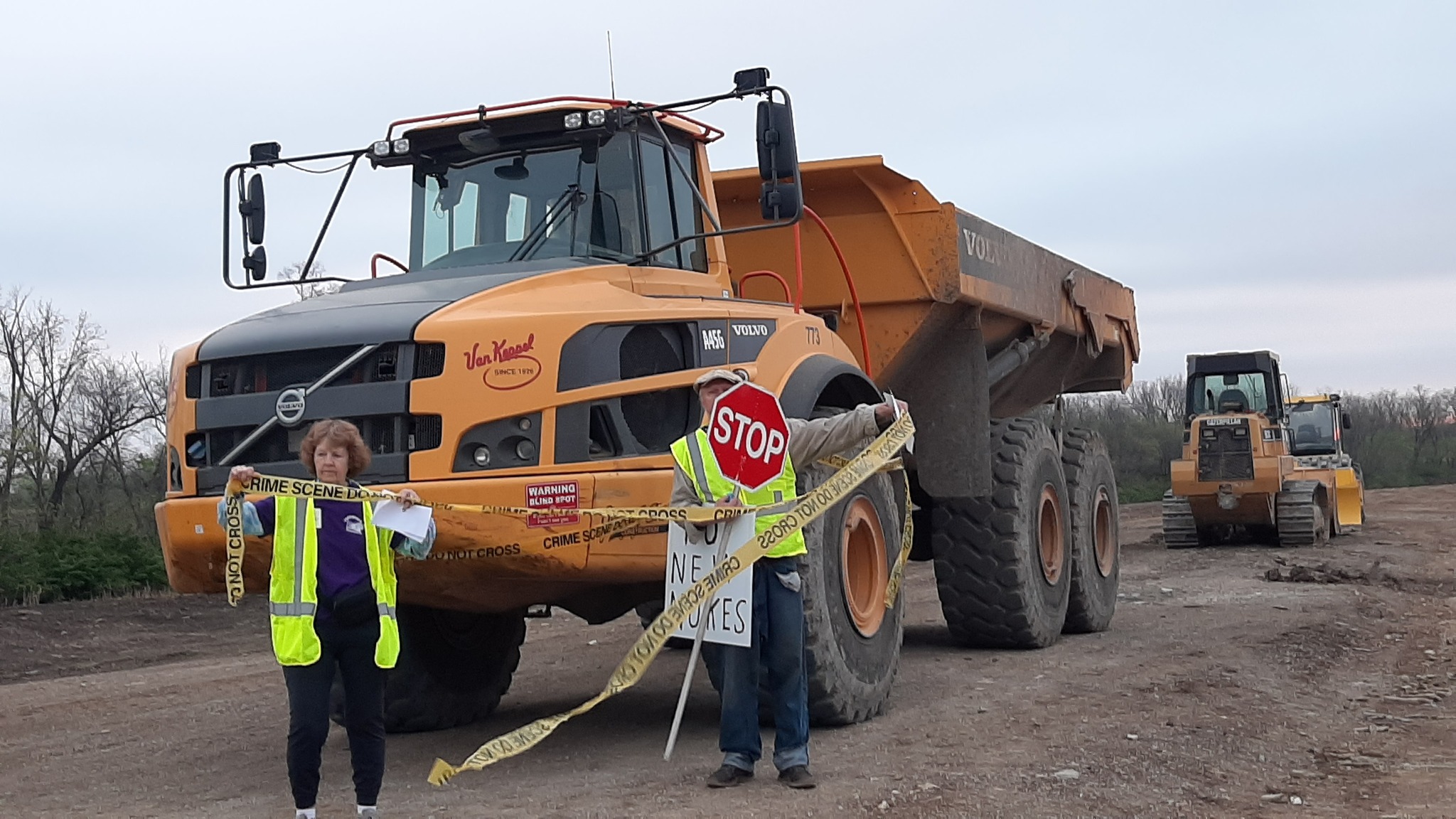
Three persons put “crime scene—do not enter” tape on a huge dump truck on the field the NSC needs flattened for the new building to make new nukes. Workmen told us, “We’re just moving dirt,” an amazing disconnect between their labor and the factory to come that will do mechanical/electronic work for US nuclear bombs.
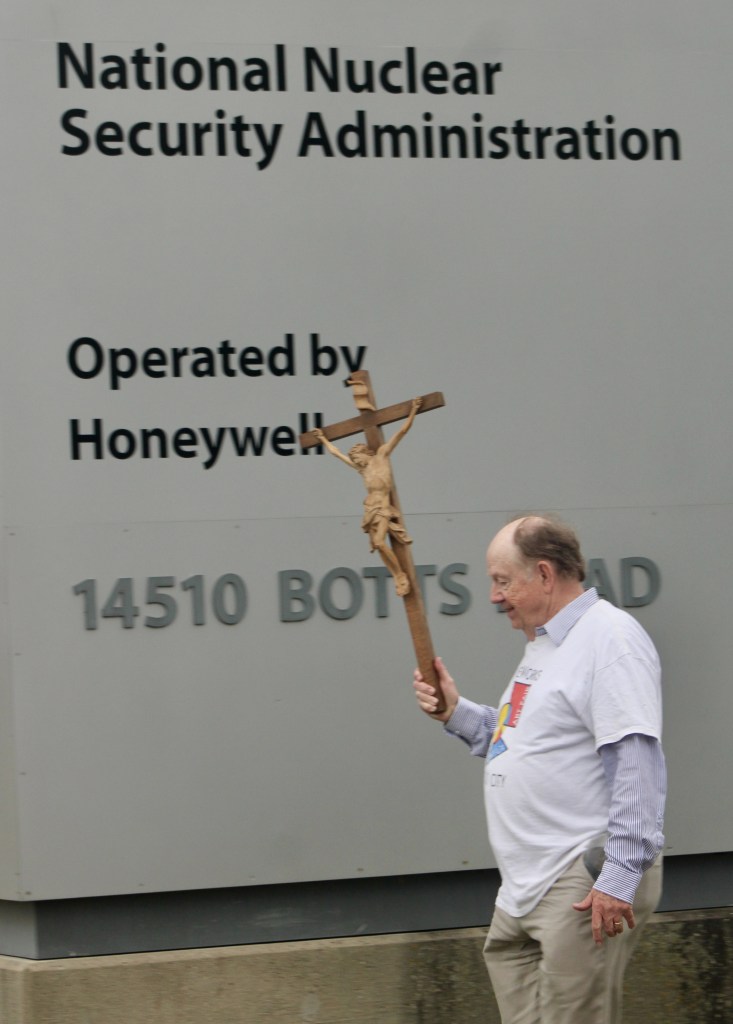
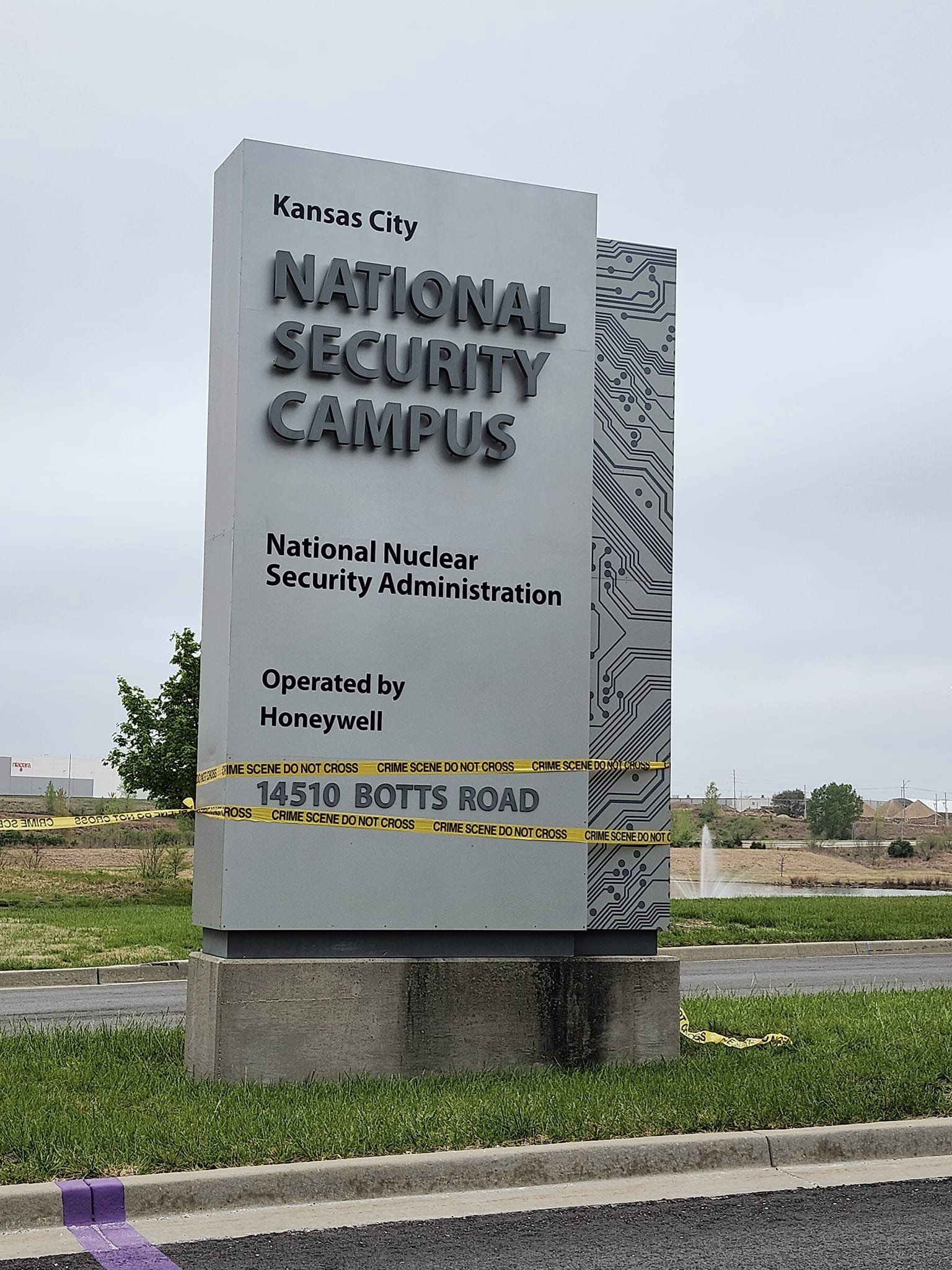
Two persons—Brian Terrell of Maloy, Iowa, and Bennette Dibben of PeaceWorks KC—put the same “crime scene” tape on the hulking sign at the NSC entry road. Brian and six others crossed the purple line indicating the NSC property line and stayed there under arrest. Our presence and commotion led the guards to place waist-high concrete highway dividers across the main entry road and sent employees to a further entry. Brian later said, “We stopped the workers from getting to the plant as usual!”
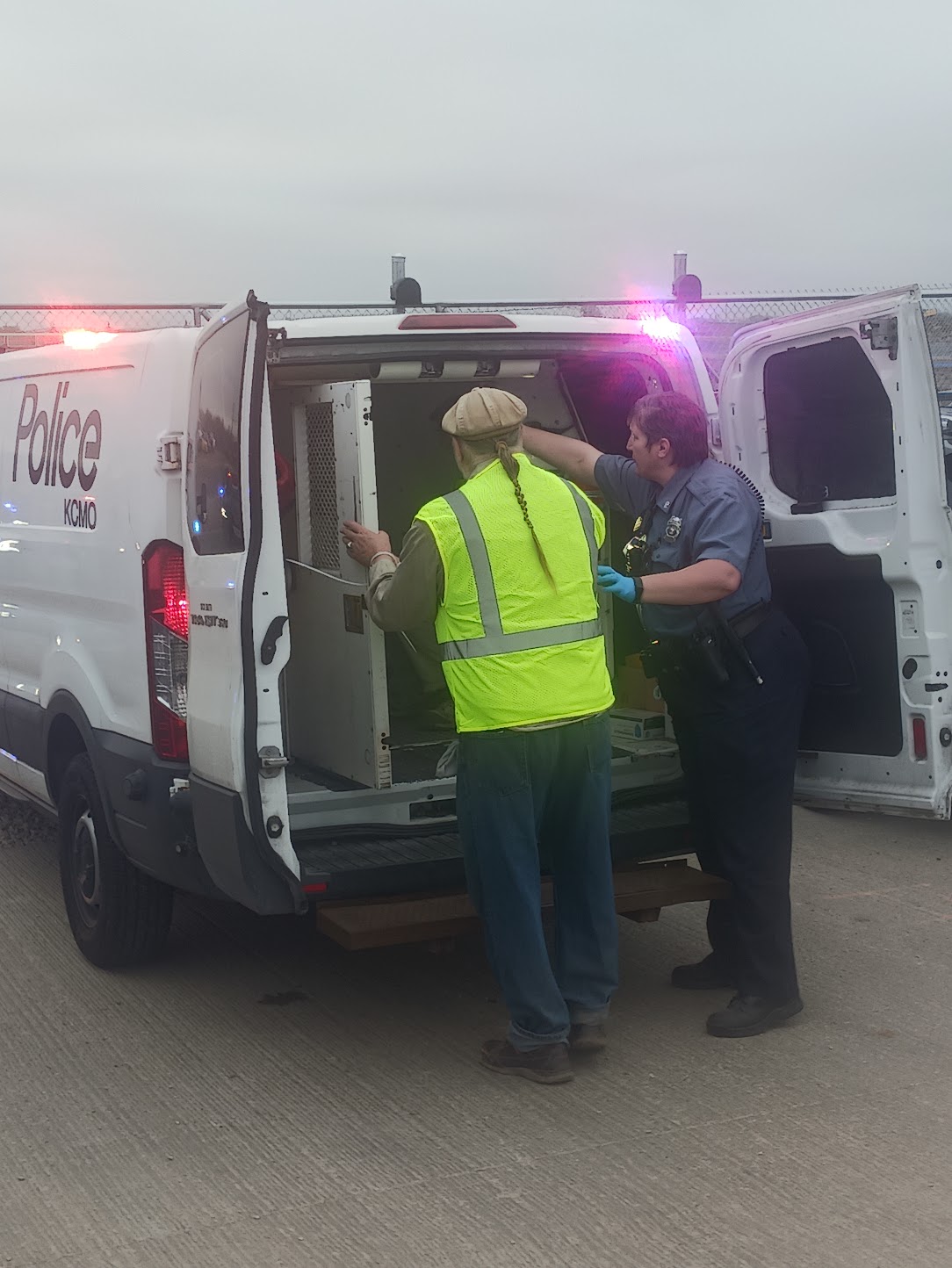
All 10 persons were driven hand-cuffed to a police office for fingerprinting, picture-taking, and release. No bond was demanded—no fee had to be paid to get out of the police station. The arraignment for most of the line-crossers will be June 3, 1:30 pm, in the KC, MO, Municipal Court.
The media, including the KC Defender (see Instagram), tracked the action. The Kansas City Star interviewed us, took pictures, and gave us a front-page story April 16 (https://www.kansascity.com/news/politics-government/article287691830.html#storylink=cpy). A photo drone flew overhead, thanks to a volunteer from the local Free Palestine group.
Later, resisters and supporters met at Cherith Brook Catholic Worker in KC MO for a feast. They soon retrieved their belongings from the nearby Jerusalem Farm, where most had settled for the April 12-15 Midwest Catholic Worker Faith and Resistance Retreat.
Overheard after the resistance:
—“Some of the drivers headed for the plant parking lot gave us a thumbs-up,” said Barbara Kass of Anathoth Community, a Catholic Worker farm near Luck, WI. “With the news about Iran and Israel this weekend, everyone is nervous. All are on alert.” Barbara spoke with the woman officer who drove her and others to the police station. The woman said, “I’ve lived in Kansas City my whole life and didn’t know this was there”—the nuclear weapon factory. Kansas Citians on the retreat said many local people do not have a clue what NSC does.
—Mike Miles, husband of Barbara Kass, said he liked doing the resistance at about 7:30 am as workers were arriving. Often PeaceWorks KC has held actions at the NSC entry road on Memorial Day or a weekend. For the future, Mike advised, “Go there when people are there!” Mike got to talk with one man walking toward the plant. Mike asked, “You work here?” The man replied, “Well, for now.” Maybe he’s re-evaluating his work at the nuclear weapon plant?
—“It was important that we held signs on the road some ways from the entry road,” said one supporter, feeling that it helped give drivers notice of our reason for descending on the area. Sarah Cool of Atlanta, GA, said it would be wise once a month or so to have a few folks hang out with peace signs near the entrance, on the public right-of-way, where people if they wished could converse with us.
—“Jane, watch out who you hang around with,” Scot Bohl of Duluth, MN, said to me about Greg Boertje-Obed. “He’s a terrorist!” This comment came after Scot, Greg, and I had succeeded in taping up an earthmover and were relaxing after release at the police station. One officer had noted that their files identify Greg as a terrorist. Well, Greg has done some Plowshare actions where government property was damaged. Scot took issue with the terrorist brand, saying, “Greg is the gentlest man I know.” Greg and his wife, Michelle, founded the Duluth, MN, Hildegard Catholic Worker House.
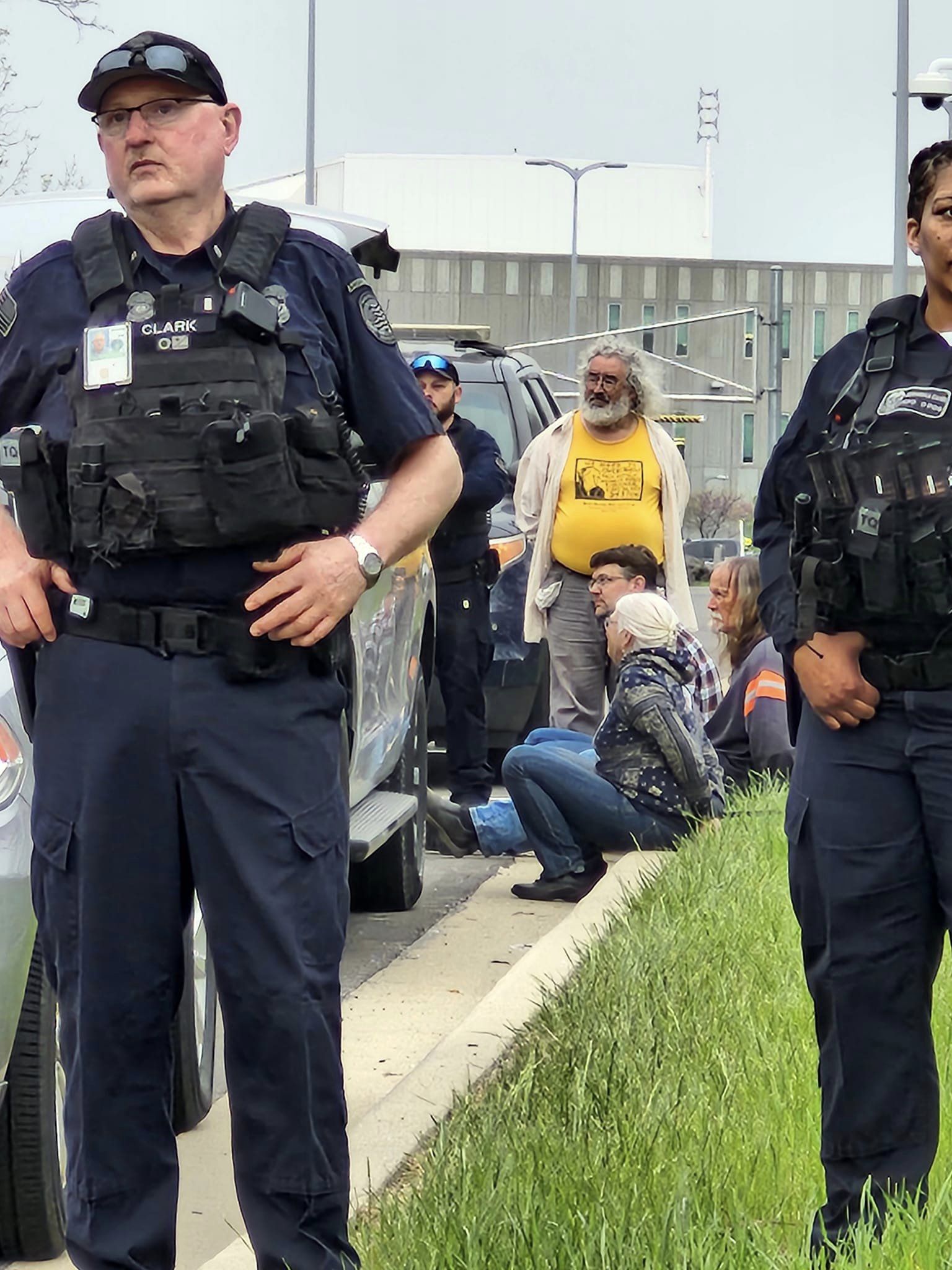
Brian Terrell, of the Strangers and Guests Catholic Worker House in Maloy, IA, said he saw progress in our KC experiences since 2010 with the guards, the police, and the courts. In the October 2023 trial of Ann Suellentrop, of the boards of Physicians for Social Responsibility and PeaceWorks, after the defense had rested its case, the prosecutor asked the judge to add the name Honeywell to the citation from the police. The judge, who had already heard the case, refused that request and declared Ann not guilty. “You are free to go!” the judge told Ann—meaning no sentence of community service, no court fine, no probation. Just free.
At this year’s April 15 event, Brian overheard a guard telling the police, in their citation, to refer to our resistance as occurring on the NNSA site (National Nuclear Security Administration site) instead of only identifying Honeywell. In other words, Honeywell simply operates the factory for NNSA. Brian underlined the national aspect of our KC efforts. Thanks, Brian!
Among the Catholic Worker families attending the retreat and resistance were Paul and Sara Freid and two of their daughters, Millie and Louise. During the April 13 evening talent show, Millie, 11, played her ukelele and sang “I’ll Fly Away.” At the police station April 15, while some of the early civil resisters were waiting to be allowed to leave the station, Paul Freid and another line-crosser arrived for processing. Recalling Millie’s rendition two days earlier, the resisters sang (softly) “I’ll Fly Away.” Indeed, there was a sense of jubilant flying away after the two-part resistance.
For the record: Besides the civil resisters named in this story (Brian, Barbara, Mike, Paul, Scot, Greg, and myself), the others to be arraigned are Tom Fox (former National Catholic Reporter editor and publisher), Eric Garbison (of Cherith Brook Catholic Worker), and Al Zook (of Luck, WI).
—Jane Stoever serves on the PeaceWorks KC Communications Team. © 2024, Jane Stoever, Jim Hannah, Creative Commons Attribution Share-Alike 4.0 International License.
xxx
by Tom Fox
Some 75 Midwest Catholic Workers gathered in Kansas City this weekend for a two-day retreat that ended April 15th in protests at the Kansas City National Nuclear Security Administration plant, operated by Honeywell, which processes 85 percent of all the non- nuclear components of the US nuclear arsenal. It has an annual budget of $1.8 billion. The US government is set to expand the plant by adding roughly 2.5 million square feet of office and manufacturing space, approximately the size of 40 football fields. Earth movers are already at the site.
The Missouri House is poised to pass a bill offering a sales tax exemption on all materials needed to expand the facility. The legislation has received bipartisan support from Kansas City-area lawmakers, who argue the expanded facility would create new high-paying jobs in the region. The House gave the bill initial approval on a voice vote last week.
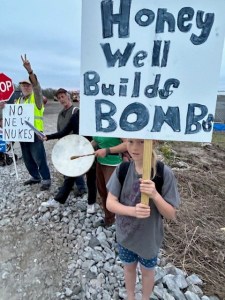
As the sun rose at the plant Monday morning, my wife, Hoa, daughter, Catherine, and I were in place, part of a group of some 50 protesters holding signs, chanting, and beating drums as we greeted plant employees as they drove up the road to the plant parking lot. The government calls the sprawling site a security campus as if it were an educational center. Holding signs such as “No New Nukes” and “Resist Nuclear weapons,” we were, at best, bothersome to the employees. No cars seemed to slow to take a good look.
Some protesters entered an adjacent lot where several huge earth movers rested in morning stillness. They wrapped yellow tape around one vehicle, marking it a “crime scene.” Soon, they had drawn the attention of several police, who cuffed them and took them away in a squad car.
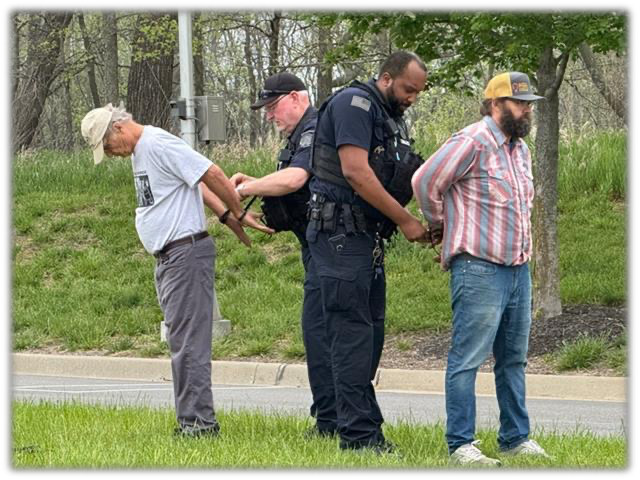
A little later, nine of us walked up the grass medium of a road leading to the “campus,” where we were quickly met by a half dozen heavily armed police dressed in flak jackets. They asked us to leave, and when we refused, they methodically handcuffed each of us behind our backs and sat us down on a cement curb. There, they tightened the hard-edged, sharp rubber cuffs. Mine dug into the skin around my wrists, eventually leaving bruise marks. They stood us up one by one, spread our legs and body-searched us. After seating us again on the curb, they asked us again to stand up and frisked us thoroughly. Once again, we were told to sit down. I asked if I could kneel to relieve pain in my lower back and was told I could but to stay immobile. Some of us lied on our backs to release stress as we waited for further instructions. Again, we were each asked to stand, and we were body searched yet again. This time, they removed everything they could from our clothing. This time, they examined our wallets, taking out each item they could find. They asked each of us if we might be concealing anything at all. I asked if they wanted my hearing aids. They allowed me to keep them. Then the police detailed every item they found on our bodies and all personal items, writing them down, line by line, on plastic bags before zipping them closed with our names attached to each.
One officer took off my cap, which read “Grandfathers for Peace,” and padded my head, wanting to make sure I wasn’t hiding a weapon. Hands cuffed, I was led to a squad car and placed in the back seat next to another protester, Paul Freid, who drove from Minnesota for the protest with his wife, Sara, and two daughters, Louise and Millie. A thick plastic panel separated us, but we could hear each other speak. He told me he subscribes to NCR, which is “the only newspaper I pay for.” We were driven some three miles north to a police holding center to be booked for trespassing. The last image I saw as I was whisked away was my wife, Hoa, sitting in a chair, holding a blue and white sign “Pope Francis: Nukes rob humanity.” She waved, and we were gone.
On the upside, I had 20 minutes in the car to speak with our driver, a man in black who identified himself as “Officer Self.” He was friendly and seemed genuinely interested in our protests. He said he did not know they were making nuclear weapons at the plant and thanked me as he dropped two of us, sitting in the back seat separated from each other and Self with thick plastic windows. As we entered the holding center, I was asked once again to spread my legs, still cuffed, and was body searched for the fifth or sixth time. Then, I was asked to stand in front of a high counter. My handcuffs were removed briefly so one of the officers could take prints of my index fingers. One of my arms was then cuffed, and I was led to a metal bench, where the officer cuffed me to the metal bench. We sat for an hour before it was my turn to have my mug shot taken. Uncuff, I stood up, was led to a wall, and stood before a camera. The police officer placed a white towel on my chest, covering the front of my Catholic Worker T- shirt and the image of Jesus sitting with his apostles. He took three photos: front, left and right. Once again, I was led to the metal bench along the wall in front of a holding cell, and once again, I was handcuffed to the bench. In front of me, on the opposite wall, I could watch a television open to a channel on which a woman was selling jewelry.
I found the police to be friendly, but the procedures they strictly followed were degrading and dis-spiriting. Perhaps their work required strict impersonal. Much of the time, I spent meditating, concentrating on my breathing, trying to relax, and reciting the Lord’s prayer and the Hail Mary, both of which kept coming into my head. The skin on my wrists felt raw and burning.
After more than two hours, I was unhandcuffed and released, and my possessions were returned in a plastic bag. The experience was tiring, but I departed with sadness. It was a sadness that I could not shake for the rest of the day. Part of it comes from having knowledge others don’t have or care to have. This is the knowledge of the sheer destructive force of nuclear weapons and the number of incidents in which they almost came to be used, mostly by accident, in the years since Hiroshima. It seems inevitable we will see nuclear disaster if we continue on the path we are on. It is a mindless path, and I fear humans have already lost control of big money and technology. Ever move toward more weapons manufacturing is justified by those who tell us the building of these weapons will “create jobs.” And, of course, big money for a relative few.
It seems that not enough of us know—or care to know—that in 2022, nine nuclear-armed states collectively spent a staggering $82.9 billion on developing their nuclear weapons programs. Leading the pack, the United States allocated a disproportionate $43.7 billion to its nuclear arsenal, surpassing the combined expenditures of all other nuclear-armed nations. Other Major Spenders: Russia ($9.6 billion) and China ($11.7 billion). Of this, I find little pride— only shame.
Moreover, the US Congressional Budget Office estimates the US plans for nuclear forces, as outlined in the 2023 budget, will cost $756 billion over the next decade to modernize our nuclear deterrent system. We cannot begin to imagine this number, which makes it easy for legislators to vote to approve it and for the rest of us to ignore what life might be like were we not wasting in on these weapons of mass destruction. Maintaining nuclear arsenals diverts resources away from essential needs like healthcare and education.
This I know. Nuclear weapons pose an existential threat to humanity. An accidental launch or deliberate use could lead to global catastrophe. Most of us who would read this essay essentially know and largely agree with me. They know we have incorporated madness into our lives and have learned somehow to go along with it. I sometimes fear it is too late and the nuclear arms race, short of a miracle, can no longer be curbed, let alone stopped. But then I recognize people all across the planet think as I do, as many of us do.
In a sign of hope, a United Nations treaty to abolish nuclear weapons continues to gain momentum despite being opposed by our government and the other nuclear-possessing nations. The Treaty on the Prohibition of Nuclear Weapons (TPNW), or the Nuclear Weapon Ban Treaty, is the first legally binding international agreement to prohibit nuclear weapons comprehensively, with the ultimate goal being their total elimination. It was adopted on 7 July 2017, opened for signature on 20 September 2017, and entered into force on 22 January 2021. The Treaty on the Prohibition of Nuclear Weapons opened for signature at the United Nations in New York on 20 September 2017 and entered into force on 22 January 2021. There are currently 93 signatories and 70 state parties. Much work must be done; it will take more civil disobedience to gain public attention.
xxx
from the KC Star
Police arrest anti-nuclear weapons protesters near KC National Security Campus
by Jonathan Shorman and Kacen Bayless
Updated April 15, 2024 11:12 a.m.
Law enforcement on Monday arrested at least 10 people outside Kansas City’s National Security Campus during a protest against nuclear weapons and a proposed expansion of the facility.
As workers arrived for their shifts, about 50 demonstrators stood along Botts Road in south Kansas City near the entrance to the campus, which includes a National Nuclear Security Administration plant that is operated by Honeywell and manufactures many non-nuclear parts for the nation’s nuclear stockpile. Organizers estimated about half of the demonstrators were from the area.
Holding signs such as “No New Nukes” and yelling anti-nuclear weapon slogans, the protesters tried their best to catch the attention of arriving workers. Ann Suellentrop, a local activist who sits on the national board of Physicians for Social Responsibility, sharply criticized U.S. efforts to build new nuclear bombs.
“We’re going the wrong way. We’re manufacturing our doom,” Suellentrop said.
Kansas City police officers arrested three protesters who ventured onto a construction site across the street. Another seven were arrested after they went on to campus land. One person wrapped “Crime Scene” tape across a National Security Campus entrance sign.
A spokesperson for the Kansas City National Security Campus didn’t immediately respond to questions about the total number of people arrested. At least some of the individuals arrested were loaded into a Kansas City police van.
A Kansas City police spokesperson, Officer Alayna Gonzalez, said the most up-to-date information she had was that 10 people were arrested on allegations of trespassing.
Protesters said Honeywell employees should use their expertise to address climate change and other global challenges. Charles Carney, an activist in the Catholic Worker movement, called the construction of bombs a “moral outrage.”
“Every bomb that is built here is a theft from our most vulnerable citizens,” Carney said.
Protesters gather outside the entrance to the National Nuclear Security Administration’s plant in south Kansas City on Monday, April 15, 2024. Police and security officers handcuffed at least 10 people who either ventured onto the expansion site or onto the plant’s land.
Jonathan Shorman jshorman@kcstar.com
The protest coincided with Tax Day, but it also came as the Missouri House is poised to pass a bill from Rep. Chris Brown, a Kansas City Republican, that would offer a sales tax exemption on all materials needed to expand the National Nuclear Security Administration’s plant.
The legislation has received bipartisan support from Kansas City-area lawmakers, who argue the expanded facility would create new high-paying jobs in the region. The House gave the bill initial approval on a voice vote last week.
“It’s an incredible economic multiplier for the area for Kansas City,” Brown said. “I think this ask on the sales tax is a small ask if you look at the long-term economic impact.”
The facility’s website states that it’s involved in non-nuclear components and Brown said during the debate that the facility would not have nuclear waste. Since moving to the Kansas City campus in 2014, the facility has grown from 2,400 employees to more than 7,000.
The expansion would provide space to accommodate the agency’s “additional volume of work,” a spokesperson said.
At the Factory That Makes Parts for World War III, Protesters Call for a Change of Heart
As most residents of Kansas City slept during the pre-dawn hours Monday, dozens of Catholic Workers rose from their beds at Cherith Brook Catholic Worker and Jerusalem Farm. After a hurried breakfast and a few strong cups of coffee, they drove half an hour to the sprawling Kansas City National Security Campus (KCNSC).
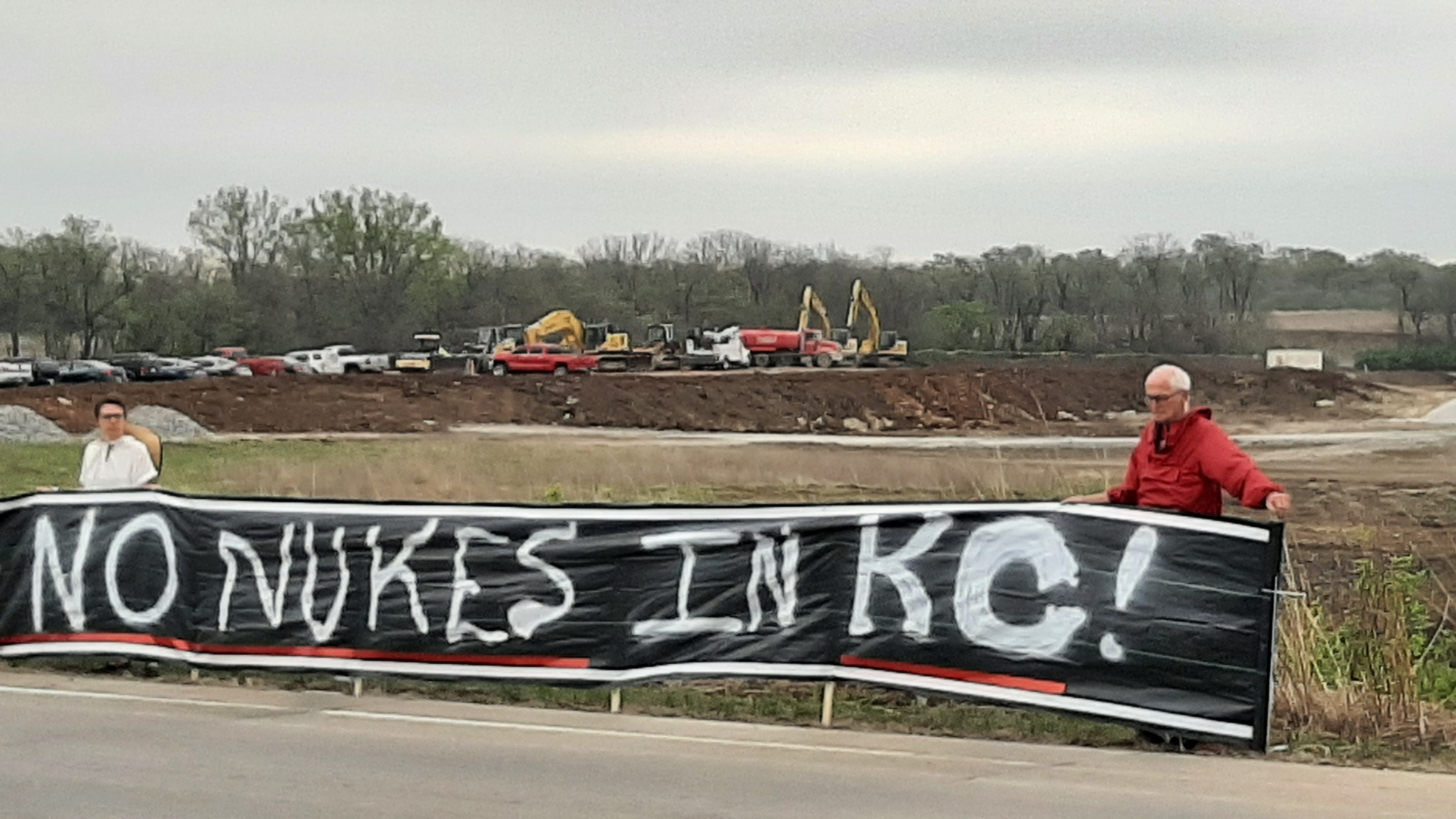
The city may have been asleep, but the factory that makes 80 percent of the components for the U.S. nuclear arsenal was lit up and busy. A long line of vehicles carried the factory’s overnight workers home as thousands more streamed up the facility’s long driveway to replace them. Across the street, giant earth-moving machines idled with their lights on, waiting to continue the construction project that would double the size of the complex.
As the overcast sky began to lighten, the Catholic Workers met up with local peace activists. Including the children, they constituted maybe fifty people—not much, compared to the 7,000 workers and billions of dollars powering the KCNSC.
Even so, their plan was to beg those workers—and the U.S. government—to stop assembling the parts necessary to have a global nuclear war.
In essence, their objective was nothing less than averting World War III.
The history of the KCNSC goes back to 1942, when Pratt & Whitney built a factory on the site to make airplane engines for World War II. In 1949, the Atomic Energy Commission hired the Bendix Corporation to build the non-nuclear components of nuclear warheads there. The plant was taken over in 1999 by Honeywell Federal Manufacturing & Technologies, which today operates it on behalf of the National Nuclear Security Administration (NNSA), a division of the U.S. Department of Energy.
The KCNSC includes state-of-the-art laboratories and manufacturing facilities that produce a range of electrical, mechanical, and engineered materials essential for nuclear weapons: fiber optics, firing systems, radar systems, specialized composite materials, containment reservoirs, casings, and more.
The facility has grown rapidly over the past decade, renting or purchasing new buildings and more than tripling its workforce, and it is gearing up to grow even more: the $3 billion construction project currently underway will expand the facility’s footprint by 2.5 million square feet.
The KCNSC plans to hire more people, too, partnering with the KC STEM Alliance to provide “urban core high school students” with funding and training so its graduates might one day work at the KCNSC.
With wages starting at $35 an hour for skilled high school graduates, the KCNSC offers “one hundred percent a path out of poverty,” Martha McCabe, director of the KC STEM Alliance, told Kansas City’s public radio station. “And not only for the individual but for their family.”
The facility operates around the clock, seven days a week, with a payroll that tops $550 billion, the radio station reports.
All of that growth is fueled by a 30-year, $1.5 trillion plan to refurbish, upgrade or replace most of the U.S. nuclear arsenal—a plan that is already over budget, according to a 2023 General Accounting Office report. The plan involves developing new submarines, missiles, planes, and command-and-control systems, and has been widely criticized for fueling a second nuclear arms race.
The program to “burn money while imperiling the world,” as Scientific American recently described it, is widely unknown among the American public. PeaceWorks Kansas City, on the other hand, has been protesting at the facility every Memorial Day for years. Last fall, Ann Suellentrop, the vice chair of the organization, asked Catholic Workers at the annual Sugar Creek Catholic Worker gathering in Iowa whether they would be willing to hold their spring Midwest Catholic Worker Faith and Resistance Retreat in Kansas City with a view to doing an action at the KCNSC.
They liked the idea, but didn’t want to come on Memorial Day, when the plant would be closed. Instead, they wanted to protest during a shift change, when some of the plant’s thousands of workers could see them.
With Monday morning’s shift change well underway, the activists began setting up in the shadow of a large sign announcing that the National Nuclear Security Campus was “operated by Honeywell.”
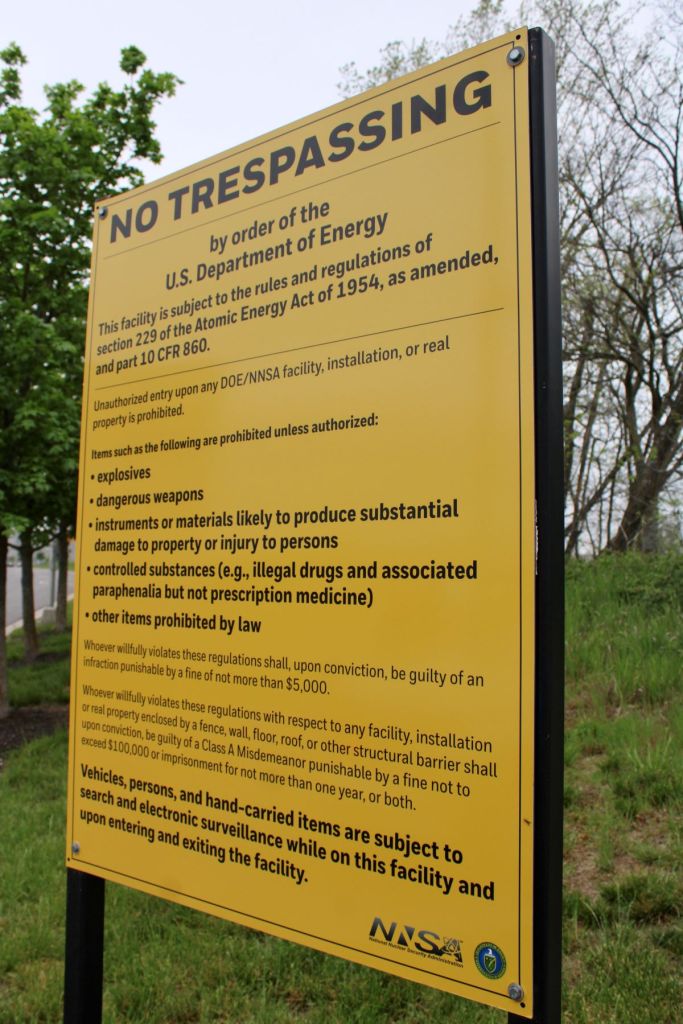
Not far away, a smaller yellow sign offered this warning:
NO TRESPASSING
By order of the
U.S. Department of EnergyThis facility is subject to the rules and regulations of
the Atomic Energy Act of 1954, as amended,
and 10 CFR 860.Unauthorized entry upon any DOE/NNSA facility, installation, or real property is prohibited.
Items such as the following are prohibited unless authorized:
– explosives
– dangerous weapons
– instruments or materials likely to produce substantial damage to property or injury to persons
Not indifferent to the irony of the warning, the protesters soon lined the roadside with signs of their own:
- World War III Starts Here
- Pope Francis: Nuclear Weapons Rob Humanity
- Honeywell: Stop Escalating Nuclear War
- We are not here to break the law but to uphold the law
- Nuclear weapons are illegal
- No taxes for bombs
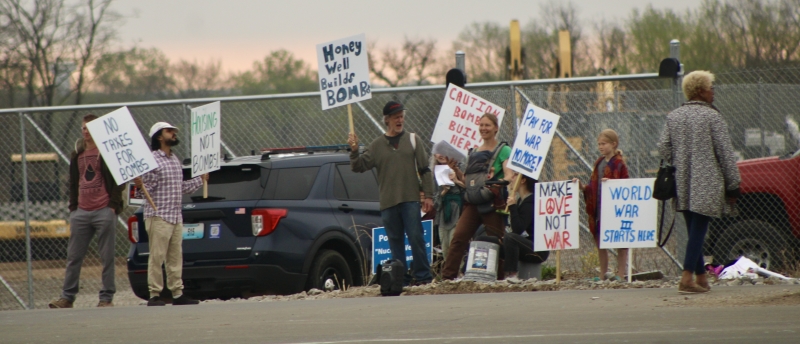

They received a remarkably positive reception from the workers driving past, said Mike Miles, who traveled more than seven hours from Anathoth Catholic Worker Farm in Luck, Wisconsin, to participate in the action.
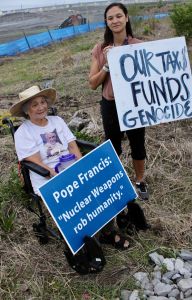
“They were reading our signs, giving thumbs up, honks, and waves,” he said.
He even had an extended conversation with one of the workers, a young man who, after parking, walked back down to the entrance to talk to Miles.
“He felt like he had to come down in person and see who are these people? Why are they here? What is this all about?” Miles said. “And I was able to have a little bit of an exchange with him. And at one point after we talked about why we were there and what this was about I asked him if he worked there, and he said, ‘Well, for now.’ My impression was that his conscience was appealed to positively in the presence that we brought to the gate.”
When the young man left Miles, he walked further into the group of protesters.
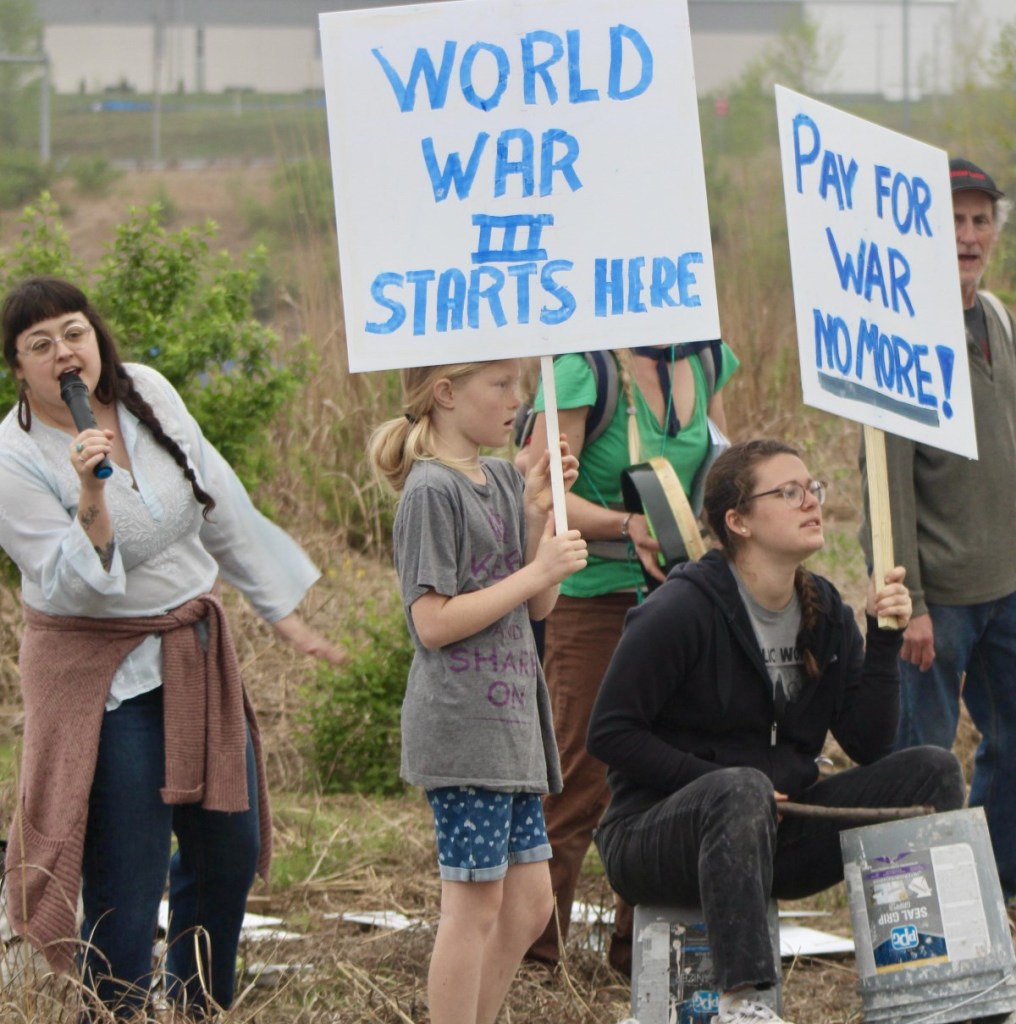
Meanwhile, Ann Suellentrop and a handful of others had walked over to the construction site. It took only a moment for an unmarked Kansas City police car to drive up.
“He was very, very laid back and was like, ‘Well, you guys don’t seem very violent to me,’ and he was just kind of very friendly,” she said.
He struck up a conversation with one of the protesters, leaving the other six free to make their way into the construction site unnoticed. They walked toward one of the earth-moving machines. When its operator saw them, he stopped. Then the site foreman came over.
“He was like, ‘I just don’t want you guys to get hurt. I’m with you, I understand, but I don’t want anybody to get hurt, and they can’t see you up there,’” Suellentrop said. “So we were like, ‘Well, we just want to put this crime scene tape around some machines,’ and he goes, ‘Okay, go ahead and put it on that one.’”
But when they approached the idling machine, its operator ran up and protested: “That’s my machine, don’t put it on my machine!”
Back at the main entrance, Brian Terrell (Strangers and Guests Catholic Worker, Maloy, Iowa) and PeaceWorks Kansas City activist Bennette Dibben were wrapping their own roll of crime scene tape around the large National Nuclear Security Campus sign.
“We are doing your job for you” by labeling the KCNSC a crime scene, Terrell told the KCNSC security officers when they finally arrived. “They got a laugh out of that, but did not remove the tape,” Terrell said. Later, the facility’s head of security arrived and tore down the tape. He “was not laughing,” Terrell noted.
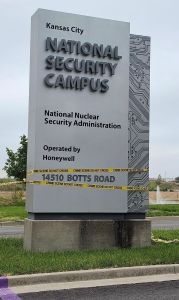
The security officers recognized some of the PeaceWorks Kansas City protesters and asked why they had come “early,” since they were used to seeing them on Memorial Day.
Quite a few of the security personnel and police officers responding to the protest had casual conversations with the activists. Austin Cook, a Catholic Worker most recently from Duluth’s Hildegard House, overheard a police captain telling one of the activists that nuclear weapons are “inevitable,” that the U.S. has to have nuclear weapons because other countries have them. But he acknowledged that it would be good if the world’s nations agreed to disarm.
Cook was busy photographing the protest, so he didn’t engage the officer. He says that if he had, he would have pointed out that the U.S. is leads the global nuclear arms race. “As a world leader, we ought to begin a discussion and forum to work together with Russia, with other countries that have nuclear bombs, to get rid of them. Unless somebody lays down their arms, nobody’s going to. Somebody has to do it first.”
A plan for global nuclear disarmament already exists in the form of the 2017 Treaty on the Prohibition of Nuclear Weapons (TPNW). It’s the first legally binding international agreement to comprehensively prohibit nuclear weapons with the ultimate goal being their total elimination. Seventy nations have ratified or acceded to the treaty as of January 2024, but neither the United States nor any other recognized nuclear-armed state has signed it.
Meanwhile, the global security and stability that nuclear weapons were supposed to ensure seems ever more tenuous. As the Catholic Workers met in small groups Saturday evening to plan the protest, word came that Iran had launched hundreds of armed drones and cruise missiles at Israel in retaliation for Israel’s deadly strike on its consulate in Syria.
The news changed the tenor of the meeting, said Kathy Kelly, the board president of World BEYOND War and co-coordinator of the Merchants of Death War Crimes Tribunal.
“The sense was, you know, we need to make this very, very clear: no nuclear weapons for World War III,” she said. “I think the news sort of catapulted us into a sense of responsibility and accountability, needing to make sure that, you know, we didn’t make ourselves irrelevant to the news at hand, but rather emphasize how relevant this is.”
The conflict between Iran and Israel was on the minds of security personnel at the KCNSC on Monday morning, too.
“They said, ‘Did you see what happened this weekend?’” Miles recalled. “And we said, ‘Well, that’s part of why we’re here, because we don’t want this thing to escalate to a nuclear exchange. I think people were just nervous about that.”
The 1,700 nuclear warheads currently deployed by the United States “is more than enough to threaten the destruction of humanity and Earth’s biosphere,” the editors of Scientific American wrote in 2023 (“The U.S.’s Plans to Modernize Nuclear Weapons Are Dangerous and Unnecessary”). Billions of people would die from the direct effects of a global nuclear exchange, with the survivors likely starving to death in the years-long nuclear winter that would follow. “Even a limited nuclear war between India and Pakistan would kill tens of millions worldwide and cause global famine,” the editors wrote.
By 8 a.m., seven of the protesters had lined up at the purple line marking the edge of the NNSC’s no-go area, with a handful of KCNSC security officers standing nearby. Then, the seven protesters walked just a few steps forward and were immediately arrested.
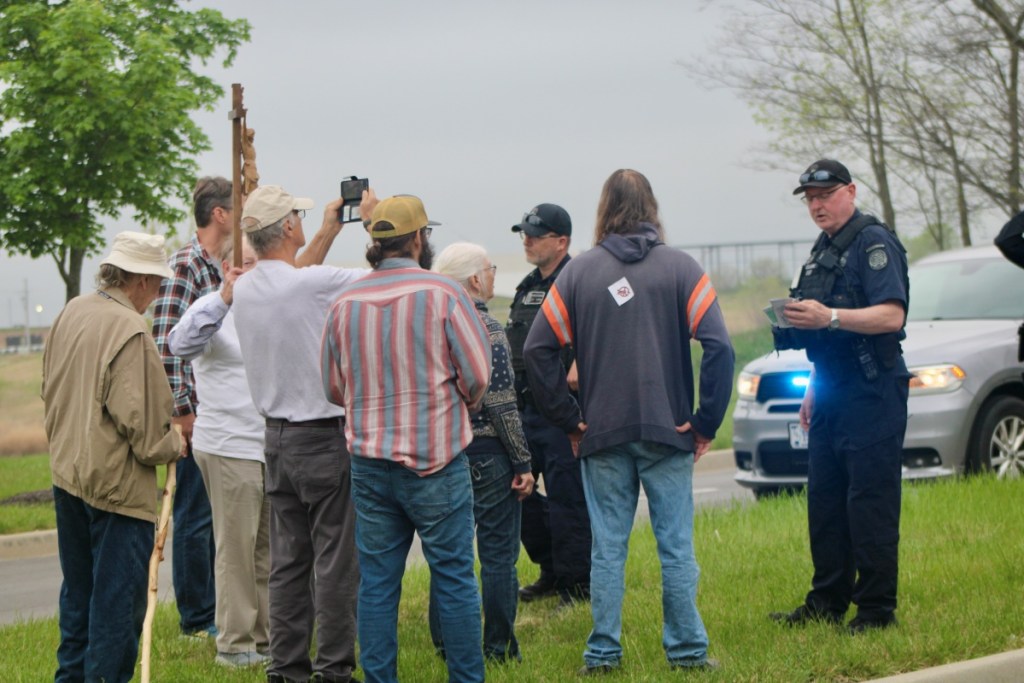
Inside the construction site, the friendly police officer warned the protesters that they had to leave. Three refused, and they were also arrested.
The arrested individuals included Paul Freid (Lake City Catholic Worker in Minnesota), Brian Terrell, Tom Fox (former publisher of National Catholic Reporter), Mike Miles and Barb Kass and Albert Zook (Anathoth Catholic Worker, Luck, Wisconsin), Greg Boertje-Obed Hildegard House Catholic Worker, Duluth, Minnesota), Jane Stoever (PeaceWorks Kansas City), Scott Bol of Duluth, Minnesota, and Eric Garbison (Cherith Brook Catholic Worker, Kansas City, Missouri).
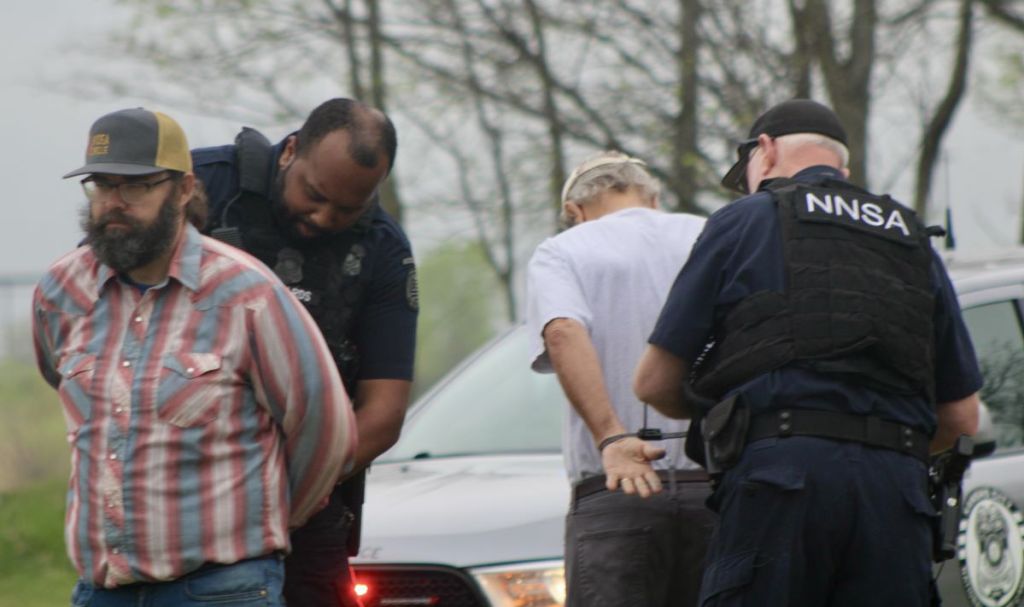
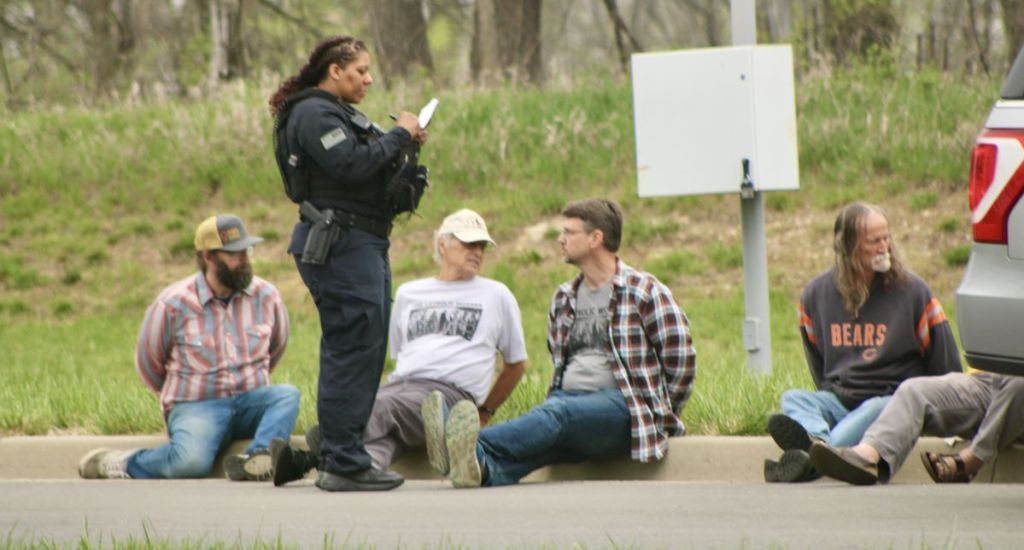
Instead of being processed at the site and released, the protesters were searched, then cuffed using zip-ties, and told to wait for police transport on the curb. After they had spent “quite a bit of time” waiting on the curb, Terrell said, KCNSC personnel drove a front-loader down the driveway and blocked it with a concrete barrier.
“It seemed a strange thing for them to do, unless they anticipated more of us risking arrest by physically blocking the road ourselves,” Terrell said.
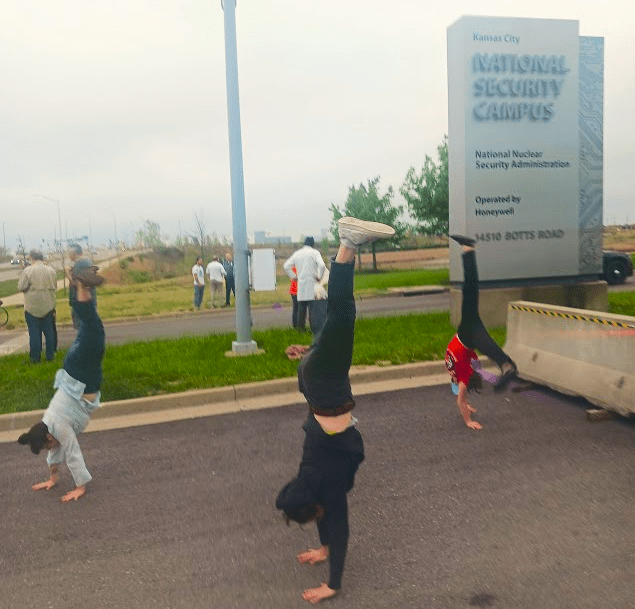
With the police transport vehicle still delayed, a handful of Catholic Workers—two teen daughters of Catholic Workers at the protest, joined by two adults—performed cartwheels and cheerleading routines near the concrete barrier placed by KCNSC security.
“I laughed out loud,” Suellentrop said. “It was hilarious! It gave a joyful, celebratory, carnival-like atmosphere to the otherwise solemn and serious tone of the police arresting us.”
After the arrested protesters had spent more than an hour waiting on the curb, the transport van finally showed up. The officer driving the van had gotten lost. She later said she had never heard of the KCNNSC and didn’t know where it was.
“So many people don’t know what this place does,” Miles said, noting that his Kansas City relatives hadn’t heard of the KCNSC, either. “That officer had lived in Kansas City her whole life and had no idea that there was a plant here that built hydrogen bombs.”
The protesters were taken to a nearby precinct station, where they were processed and released. They will be arraigned on June 3in the Kansas City Municipal Court.
By 1 p.m., they were back at Cherith Brook Catholic Worker House enjoying a real Kansas City barbecue. As they ate, they assessed how the morning had gone.
“The general sense was that we accomplished everything we set out to do in all the planning that we put into it over the weekend,” Miles said. The highlight, he said, was interacting with the KCNSC employees. “They were reading our signs and, you know, understanding, wow, there’s people here who don’t like what we manufacture out here but they’re probably right not to like that we manufacture hydrogen bombs.”
So: Fifty people set out on a Monday morning to confront the trillion-dollar machine turning out the nuts and bolts needed for a nuclear Armageddon. Did they accomplish anything?
The Kansas City Star filed a 500-word paint-by-number protest story that gave far more ink to supporters of the KCNSC project than its critics, quoting a Republican state representative as saying that the KCNSC is “an incredible economic multiplier for the area.” He’s proposing giving the construction project a sales tax exemption.
The paper also quoted the standard KCNSC press statement: “We respect the rights of our neighbors to express their opinions through lawful demonstrations. This is the type of freedom we protect through our national security mission…. The dedicated employees who work at our facility are proud of our work to help safeguard our nation.”
Of course, for Catholic Workers, such actions have never been primarily about being “effective.”
“With non-violent action, it is important not to focus too much on what you will achieve,” Martha Hennessy, granddaughter of Dorothy Day, told an audience in Scotland last month. “You do what you do, not because of the results or that you have stunning success or any of that.”
Kelly, for her part, is convinced that young people within the environmental movement will eventually clue into the fact that the world is spending trillions of dollars on systems that threaten all life on the planet.
“I think people will start to wake up,” she said. “I’m expecting that.”
In the meantime, she said, actions like the one on Monday can plant the seeds of awareness, as with the curious young worker who interacted with the activists. And such actions provide a faithful witness, too—an invitation to trust God, not weapons of mass destruction, for our well-being.
“Catholic Workers are so good about saying…there’s no security that Christians could ever find in killing other people,” she said. She pointed to the witness of Archbishop John Wester and Pope Francis as voices speaking out for the total abolition of nuclear weapons. “In a very profound sense, we are in a moment when Christianity’s voice is crucially needed.”